Architectural Highlights
Among the many architectural highlights to be enjoyed at the Córdoba Mosque-Cathedral one of the most famous is the Hypostyle Prayer Hall. This huge interior space is filled with around1250 columns, some of which date back to the building's Gothic history, while others were given as gifts from Governors of the many Iberian provinces. The seemingly infinite rows of red and white horseshoe arches are dazzlingly beautiful and have come to be representative of Islamic architecture in al-Andalus.
The next architectural gem on any visit should be the Mihrab, a prayer chamber in the Mosque-Cathedral pointing in the direction of Mecca, added under al-Hakam II. Directly in front of the Mihrab lies the lavishly decorated Maqsura, a prayer space reserved especially for the caliph, serving to both express his authority and to allow him to pray safely. Taken together, the Mihrab and Maqsura show how Islamic architecture brought together religion and leadership within the same space.
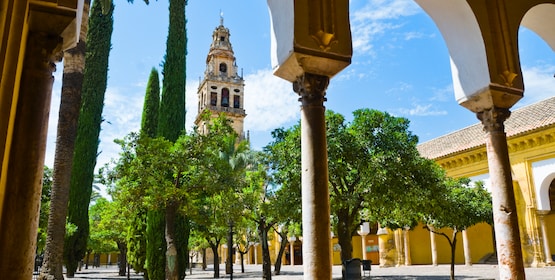
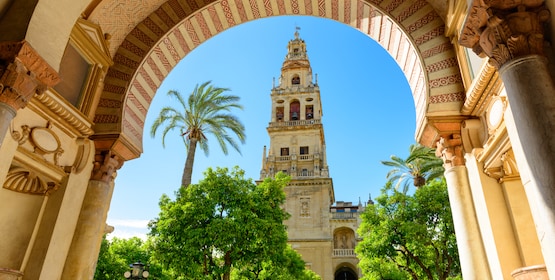
The Orange Tree Courtyard, where you can also see palm trees, olive trees and cypresses, has expanded and gone through many changes over the course of history. In Islamic times it was used for public functions, including teaching and administering justice, as well as being a space for carrying out ritual ablutions before prayer time. The cloisters visitors can see today are from the beginning of the 16th century, when the Bishop commissioned legendary architect Hernán Ruiz the Elder to rebuild them. A large cistern lies beneath the courtyard, which once provided water for ablutions
The city’s iconic Bell Tower, which stands at an impressive 54 metres tall, was originally the Muslim minaret, used to call the faithful to prayer and symbolise Islamic authority throughout the city of Córdoba. After the Christian conquest in 1236, the structure was quickly transformed into a bell tower and used until 1589, when it was damaged by an earthquake, prompting the building of a new tower around the original Caliphate minaret, designed by Hernán Ruiz III. The ringing of the bells is still at the centre of Cathedral life to this day.
Built in the 16th century after the Christian reconquest, the Renaissance Cathedral Nave represented a notably Christian architectural space and is another highlight of the Córdoba Mosque-Cathedral's history. Featuring high vaults, a cruciform plan, and elaborate Renaissance decoration, the vertical scale of the nave is a remarkable contrast with the low columns and arches of the mosque.